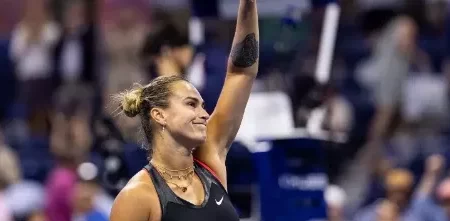

World number one tennis player, Aryna Sabalenka, commented on her poor performances at the tournaments in Doha and Dubai. She explained these setbacks by pointing to fatigue accumulated after the Australian Open, where she typically achieves significant success.
“For the past three years, I haven’t been able to perform well at these competitions. It’s a good problem to have – I go so far at the Australian Open that I’m exhausted in Doha and Dubai,” Sabalenka stated.
She added, “This time, I was overtired and sick. It was a tough month. February is generally not my month.”
However, Sabalenka expressed her positive outlook on the upcoming tournament: “But I love the Indian Wells tournament. It’s called the fifth ‘Grand Slam’, so I’m charged up. I want to go as far as possible.”
Regarding her defeat at the Australian Open, she was asked if she had moved past it and if it would motivate her. “Of course,” Sabalenka replied. “Such обидные (painful) defeats always motivate you to work harder.”
She continued, “It was tough, but it’s in the past. It took me a week, maybe a little more, to stop thinking about it and finally move on. Now I’m ready to take revenge if I have the opportunity.”
Addressing a question about psychological help, prompted by Maddie Keys’ experience, Sabalenka shared her perspective: “I have been working with psychologists for 4 or 5 years, so I know a lot about it. I’ve had many difficult situations in my life, and I’ve coped with them quite well on my own.”
Sabalenka emphasized her preference for self-reliance in challenging times: “I cope better with difficult moments on my own, without anyone else’s help. I don’t mean to say there’s a right or wrong approach. It all depends on what kind of person you are and what you need.”
She highlighted the importance of her team: “I have a wonderful team, they are like family to me, they are my main support. I don’t need someone from the outside to help me cope with difficulties.”
In conclusion, Sabalenka acknowledged the validity of different approaches to psychological support: “But it’s great that she realized that she needed it and sought help. That’s all. For her, it’s the best option. For me – not so much. We are all different, so there is no ultimately right or wrong approach,” Sabalenka said at the press conference.